Article
Mar 11, 2025
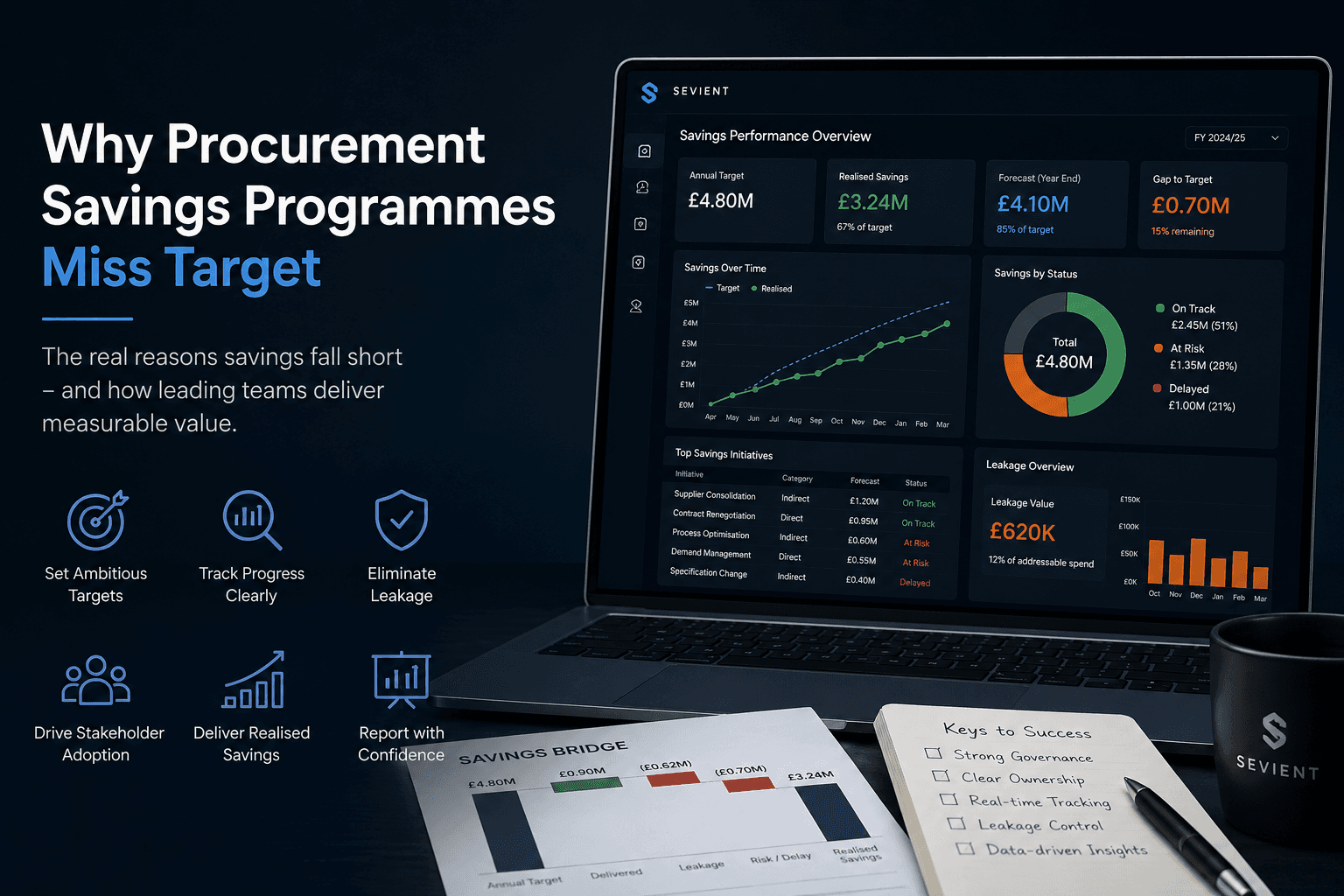
Many procurement savings programmes start strong but fail to convert pipeline into realised value. Here are the most common reasons targets are missed—and how leading teams stay on track.
Introduction
Procurement has evolved. In many organisations, the function is no longer judged purely on sourcing activity, tender compliance or negotiated discounts. It is increasingly judged on one question:
What measurable value did procurement deliver?
That shift has raised expectations. Boards want savings. Finance teams want evidence. Operational leaders want better service levels. Executive teams want confidence that commercial initiatives are converting into real financial outcomes.
Yet despite strong intentions, many procurement savings programmes finish the year below target.
Approved opportunities may look healthy in Q1. Pipelines may appear strong in dashboards. Category plans may be ambitious. But by year-end, realised savings often fall short of what was expected.
Why does this happen?
In most cases, the issue is not a lack of ideas. It is the gap between identifying opportunities and consistently converting them into measurable, sustained value.
This article explores the most common reasons procurement savings programmes miss target — and what leading teams do differently.
What is a Procurement Savings Programme?
A procurement savings programme is the structured portfolio of initiatives designed to reduce third-party spend, improve value, or avoid unnecessary future cost across a financial year.
These initiatives often include:
supplier renegotiations
demand management
product standardisation
supplier consolidation
contract compliance improvement
specification changes
process efficiency initiatives
inflation mitigation actions
commercial restructuring
Savings programmes are usually linked to annual financial plans and are expected to contribute measurable value against budget targets.
In theory, the model is simple:
Identify opportunity
Execute initiative
Track delivery
Report realised value
In practice, each stage contains risks.
The Difference Between Pipeline, Forecasted and Realised Savings
One of the biggest causes of confusion in procurement reporting is the failure to distinguish between three very different concepts.
Pipeline Savings
Potential opportunities that have been identified but not yet delivered.
Example: A planned supplier renegotiation expected to save £250k.
Forecasted Savings
Expected savings based on initiatives in progress or likely to land.
Example: £150k expected from a contract starting in September.
Realised Savings
Savings already evidenced through actual spend, pricing, demand reduction or measurable financial impact.
Example: Unit price reduced from £12 to £10 across 40,000 purchases already made.
These categories all matter. But they are not interchangeable.
Many programmes miss target because pipeline value is mistaken for certainty, and forecasted value is reported too confidently.
Why Procurement Savings Programmes Miss Target
1. Opportunities Are Easier to Identify Than Deliver
Most procurement teams can identify opportunities. Skilled category managers regularly spot pricing gaps, supplier rationalisation opportunities, demand reduction ideas and commercial leverage points.
The harder part is execution.
An initiative may require:
stakeholder approval
specification changes
supplier onboarding
contract sign-off
operational adoption
policy changes
data cleansing
internal governance approvals
Every additional dependency increases delivery risk.
A £500k opportunity on paper can become £0 if execution stalls.
What Good Teams Do
Strong teams assess delivery complexity early, not just headline value. They prioritise initiatives that are both valuable and executable.
2. Weak Baselines Create Unreliable Savings Numbers
Savings claims are only as strong as the baseline behind them.
If historical pricing, demand volumes or supplier spend positions are inaccurate, reported results become questionable.
Example
A team reports £300k savings from a new contract. But historical demand has dropped significantly, meaning part of the reduction came from lower consumption rather than procurement action.
Without a clear baseline, leadership confidence falls.
Common Baseline Issues
inconsistent historic pricing
changing product mix
missing volume assumptions
one-off prior year anomalies
inflation not separated from true savings
supplier substitutions not normalised
What Good Teams Do
Best-in-class functions define baseline methodology clearly and apply it consistently across initiatives.
3. Forecasted Savings Are Reported Too Early
Many programmes become over-optimistic because expected value is counted before delivery is evidenced.
This often happens when:
contracts are signed but not yet live
implementation is delayed
buying behaviour has not changed
volumes are lower than expected
users continue purchasing elsewhere
The result is a reporting gap between what was expected and what actually lands.
What Good Teams Do
They maintain separate views for:
approved pipeline
forecasted delivery
realised value
This creates honesty in reporting and enables earlier intervention.
4. Spend Leakage Erodes Negotiated Value
A supplier can offer better pricing. Procurement can negotiate excellent terms. But if buying behaviour does not follow the intended route, value leaks away.
Typical Leakage Examples
off-contract purchases
legacy suppliers still being used
old prices still paid
duplicate buying across departments
fragmented low-volume orders
maverick spend outside agreed channels
uncontrolled demand growth
Leakage is one of the most underestimated causes of missed savings targets.
The contract may be successful. The commercial outcome may still fail.
What Good Teams Do
They monitor post-award spend continuously and flag exceptions quickly.
5. Ownership Is Unclear
Savings delivery rarely sits with procurement alone.
It may require input from:
finance
budget holders
operations
clinical stakeholders
IT
suppliers
legal teams
Where ownership is unclear, initiatives drift.
Typical signs include:
no named accountable owner
no deadline
no milestone tracking
unresolved blockers
decisions repeatedly delayed
What Good Teams Do
They assign ownership at initiative level, with visible status, dates and escalation routes.
6. Reporting Happens Too Late
Many organisations still rely on monthly or quarterly manual reporting cycles.
By the time issues appear in a report:
the initiative may already be delayed
spend leakage may have continued for months
forecast gaps may be too large to recover
leaders may have no time left to intervene
Late reporting turns manageable issues into year-end problems.
What Good Teams Do
They use live or frequent reporting with early warning indicators.
7. Too Much Time Is Spent Managing Spreadsheets
Spreadsheets remain common in procurement savings tracking. They are flexible and familiar — but they become fragile at scale.
Typical Spreadsheet Problems
version control issues
broken formulas
inconsistent logic
manual updates
delayed consolidation
weak audit trail
limited executive visibility
When teams spend more time updating trackers than managing outcomes, performance suffers.
What Good Teams Do
They automate reporting where possible and free teams to focus on action.
8. Leadership Cannot See What Matters Quickly
Senior stakeholders usually do not want dozens of tabs or lengthy commentary packs.
They want quick answers:
Are we on target?
Where is risk increasing?
What has been realised this month?
Which initiatives need support?
Where is leakage occurring?
What is the likely year-end position?
If leadership cannot see the position clearly, decisions slow down.
What Good Teams Do
They use concise executive reporting focused on decisions, not data overload.
Metrics High-Performing Procurement Teams Track
Leading organisations typically monitor a balanced set of metrics:
Value Metrics
annual target
realised savings YTD
forecasted year-end savings
gap to target
Delivery Metrics
initiatives on track
initiatives at risk
delayed projects
delivered projects
Control Metrics
leakage value
off-contract spend
duplicate spend signals
supplier compliance trends
Strategic Metrics
category performance
savings by initiative type
stakeholder adoption
recurring vs one-off value
The best teams do not rely on one number. They manage the full picture.
What Leading Procurement Teams Do Differently
While every organisation is different, strong performers usually share the same habits.
1. They Prioritise Realisable Value
Not all opportunities are equal. They focus on what can actually be delivered.
2. They Separate Pipeline, Forecast and Realised
Clear definitions improve trust and decision-making.
3. They Monitor Continuously
They do not wait until quarter-end to spot issues.
4. They Govern Initiatives Properly
Owners, dates and milestones are visible.
5. They Tackle Leakage Early
Value capture matters as much as negotiation.
6. They Report for Executives
Simple, decision-ready insights beat complex trackers.
How Technology Helps
Modern procurement performance platforms can strengthen delivery by providing:
automated savings tracking
forecast visibility
initiative governance dashboards
leakage detection
exception alerts
category insights
executive-ready reporting
auditable methodology
Technology does not replace procurement capability. It amplifies it.
Final Thought
Most procurement savings programmes do not fail because teams lack commercial skill.
They fail because opportunity is not translated into disciplined execution, visible control and measurable value.
The future of procurement performance belongs to organisations that can do three things consistently:
identify value, deliver value, and prove value.
That is where savings targets stop being aspirations — and become results.