Article
Jul 23, 2025
Off-contract spend, price drift, duplicate buying, and poor compliance quietly erode savings. Learn how procurement leakage happens and how leading teams prevent it.
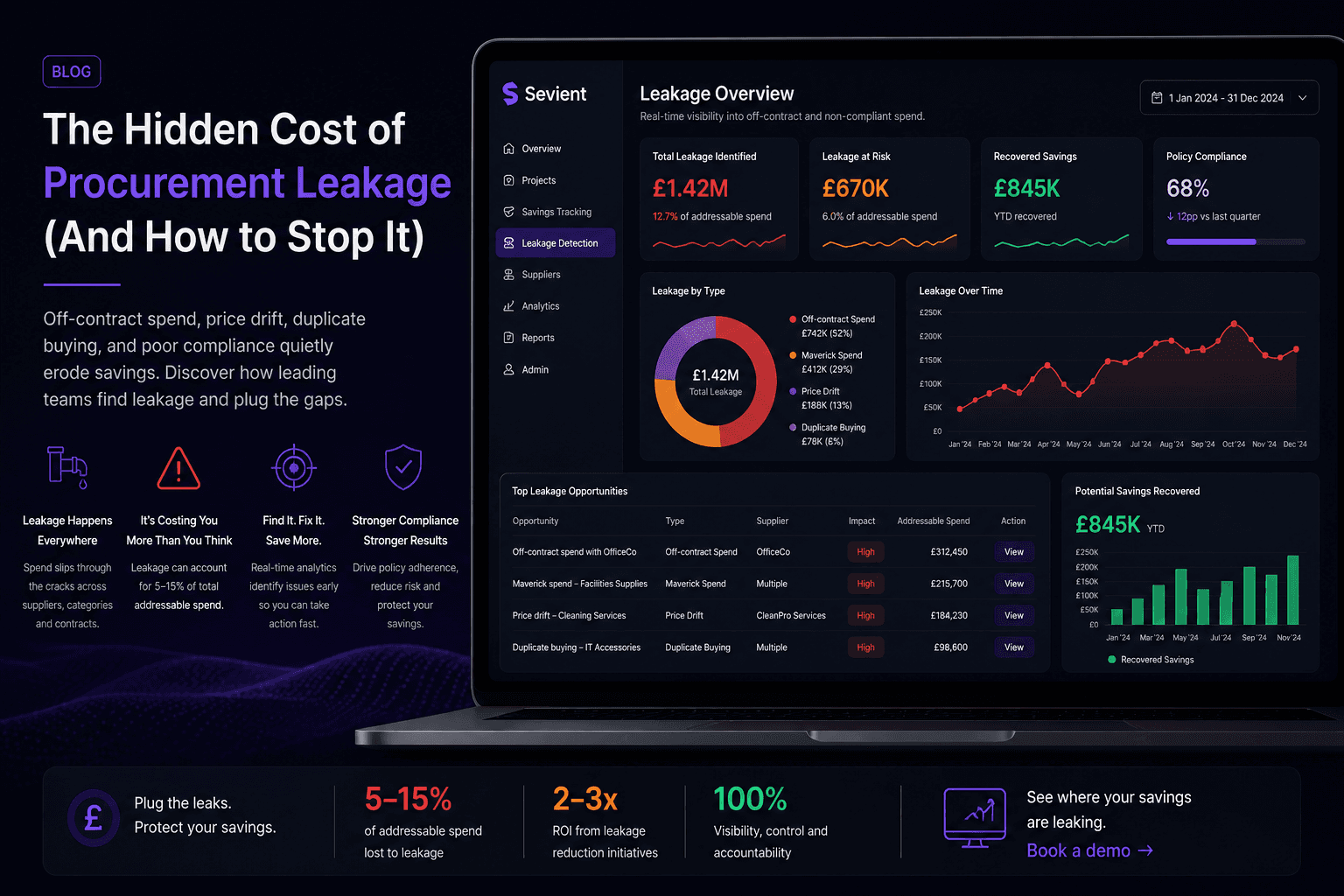
The Hidden Cost of Procurement Leakage (And How to Stop It)
Introduction
Many organisations believe procurement savings are delivered once a contract is signed or a target is agreed. In reality, value can quietly disappear after the negotiation stage through poor compliance, off-contract buying, duplicate purchasing, price drift, and missed opportunities.
This is known as procurement leakage — and for many businesses, it represents one of the largest hidden drains on financial performance.
While teams focus on sourcing events and supplier negotiations, leakage often happens in day-to-day purchasing activity across departments, sites, and systems. Without visibility, organisations may believe they are saving money while losing value in the background.
What Is Procurement Leakage?
Procurement leakage is the gap between the savings you expected to realise and the actual value delivered.
It typically appears when buying behaviour moves away from agreed controls, preferred suppliers, negotiated pricing, or approved strategies.
Examples include:
Buying outside agreed contracts
Paying higher prices than negotiated rates
Duplicate orders across teams
Low compliance with preferred suppliers
Unapproved category spend
Missed consolidation opportunities
Poor demand planning creating unnecessary purchases
Each individual issue may seem small, but across hundreds or thousands of transactions, the financial impact becomes significant.
Why Leakage Is So Expensive
Leakage rarely appears as one major event. It happens gradually through many small decisions spread across the organisation.
That makes it dangerous.
A business may report savings targets on paper while actual spend tells a different story. Forecasts become less reliable, finance teams lose confidence in reported results, and leadership lacks a clear view of true procurement performance.
In many organisations, leakage can account for a meaningful percentage of addressable spend every year.
Common Causes of Leakage
1. Lack of Spend Visibility
If procurement data sits across multiple reports, spreadsheets, and systems, issues are harder to detect early.
2. Weak Compliance Controls
Preferred suppliers and agreed pricing only create value when buyers actually use them.
3. Manual Monitoring
Reviewing spend line by line in spreadsheets is slow, reactive, and easy to miss.
4. Decentralised Buying
Different teams may purchase the same items in different ways without coordination.
5. No Real-Time Alerts
By the time issues are found in monthly reporting, the money has already been spent.
How Leading Teams Prevent Leakage
Modern procurement teams are moving from reactive reporting to continuous control.
Instead of waiting for month-end reviews, they use live data to identify risks as they happen and take action quickly.
That includes:
Monitoring off-contract spend in real time
Flagging price anomalies automatically
Detecting duplicate buying patterns
Tracking supplier compliance
Surfacing missed savings opportunities
Measuring recovered value over time
The result is stronger governance, better forecasting, and higher realised savings.
Why Traditional Spreadsheets Fall Short
Spreadsheets are useful for static reporting, but leakage is a dynamic problem.
By the time reports are updated, circulated, and reviewed, opportunities may already be lost.
Manual processes also create challenges with:
Data accuracy
Version control
Slow decision-making
Limited audit trail
Poor scalability across multiple categories or sites
As organisations grow, spreadsheet-based control becomes harder to sustain.
Turning Leakage Into Opportunity
The good news is that leakage is not just a risk — it is also an opportunity.
Every pound recovered from unnecessary spend improves margin without increasing revenue.
Unlike many transformation programmes, leakage reduction often delivers measurable financial results quickly because the value already exists inside current spend.
The challenge is visibility and action.
How Sevient Helps
Sevient helps procurement teams uncover hidden leakage, monitor savings delivery, and turn ERP data into clear, measurable results.
With intelligent monitoring and real-time insights, teams can:
Spot leakage faster
Protect negotiated savings
Improve compliance
Strengthen forecasting
Demonstrate value to finance and leadership
Final Thoughts
Negotiated savings mean little if value leaks away after the contract is signed.
The most effective procurement teams do not stop at sourcing — they manage delivery, monitor behaviour, and protect savings continuously.
If you can see where value is leaking, you can stop it.