Article
Apr 28, 2026
Savings delivered means little if stakeholders do not trust the numbers. Learn how procurement teams can improve visibility, reporting, and credibility with finance and executive leadership.
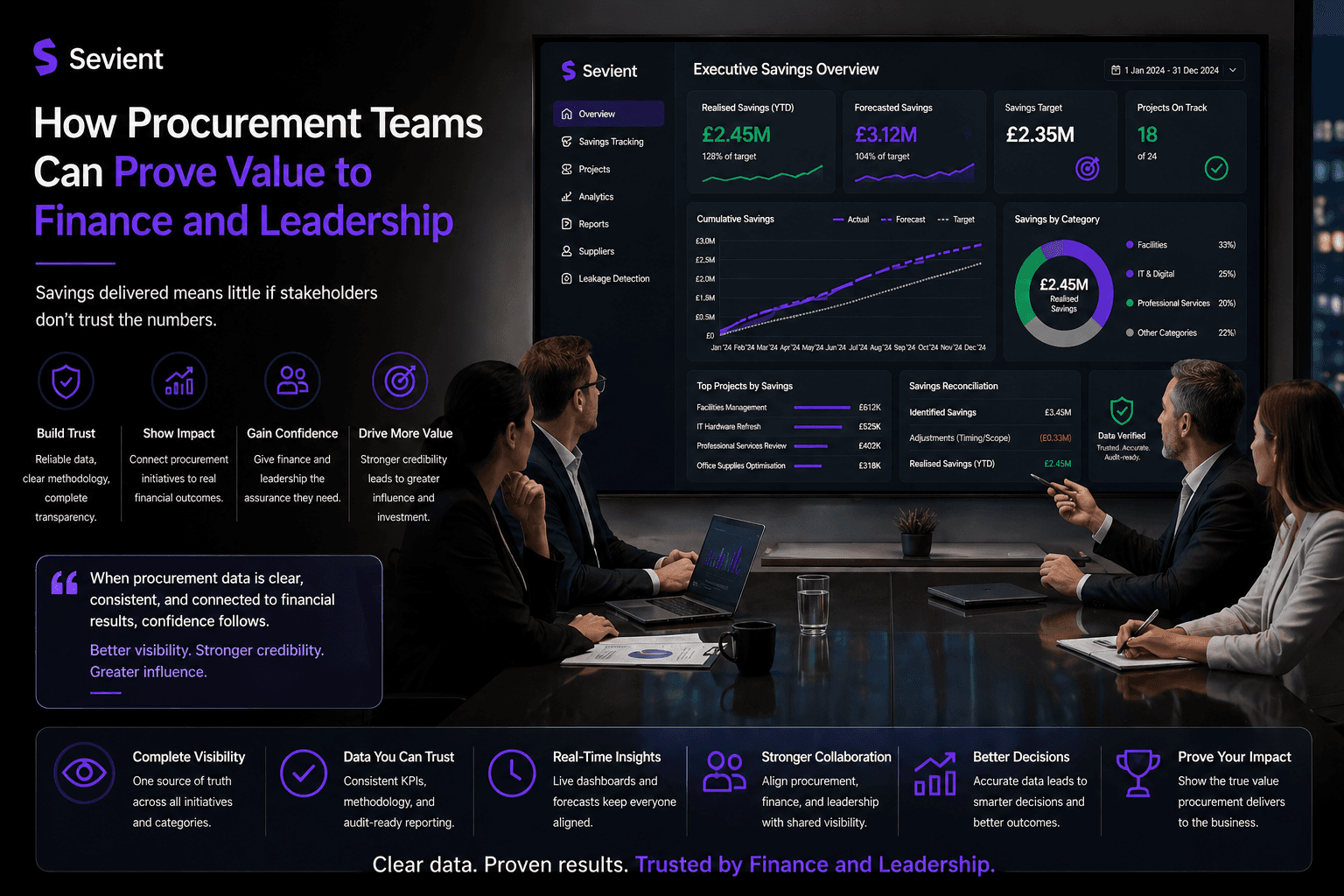
How Procurement Teams Can Prove Value to Finance and Leadership
Introduction
Procurement teams are often measured by the savings they deliver, the risks they reduce, and the value they create across the organisation. Yet many still face the same challenge: proving that impact to finance and leadership.
Even when strong work is happening behind the scenes, poor reporting, delayed updates, and unclear methodologies can create doubt. Savings may be delivered operationally, but if stakeholders do not trust the numbers, procurement’s influence is limited.
To gain credibility at the executive level, procurement needs more than results. It needs visibility, consistency, and confidence.
Why Proving Value Is Harder Than Delivering It
Negotiating better contracts, consolidating suppliers, and reducing costs are critical achievements. But those actions alone do not guarantee recognition.
Finance leaders want evidence. Executive teams want clarity. Boards want outcomes tied to business performance.
Without a clear way to demonstrate delivered value, procurement risks being seen as a support function rather than a strategic driver.
That can affect:
Budget support
Investment in technology
Headcount growth
Executive influence
Cross-functional collaboration
Long-term transformation priorities
Why Finance Sometimes Challenges Procurement Numbers
This tension is common and understandable.
Finance teams are responsible for accuracy, controls, and financial reporting. If savings claims are based on inconsistent spreadsheets or unclear assumptions, they will naturally ask questions.
Common concerns include:
How were savings calculated?
Have they actually been realised?
Are these one-off or recurring benefits?
Have market changes been considered?
Is the baseline valid?
Can the data be audited?
When procurement cannot answer quickly and confidently, trust slows down.
What Leadership Wants to See
Senior stakeholders do not need more spreadsheets. They need concise, decision-ready insight.
Strong procurement reporting should clearly show:
Savings delivered year to date
Forecasted savings by year-end
Progress against targets
Projects on track or at risk
Key risks and opportunities
Category performance trends
Actions being taken
The goal is not to overwhelm leadership with data. It is to give them confidence in direction and results.
How Better Reporting Builds Trust
Clear reporting changes how procurement is perceived.
When data is timely, consistent, and easy to understand, stakeholders become more confident in the function.
That leads to:
Stronger Executive Confidence
Leaders trust reported outcomes and support future initiatives.
Better Finance Alignment
Shared numbers reduce friction and speed up decisions.
Greater Strategic Influence
Procurement earns a stronger seat at the table.
Faster Action
At-risk projects and missed targets are visible earlier.
More Recognition
Success becomes easier to communicate across the business.
Why Real-Time Visibility Changes the Conversation
Traditional reporting often looks backwards. By the time monthly packs are shared, opportunities may already be lost.
Real-time visibility allows procurement and leadership to act sooner.
Instead of asking what happened last month, the conversation becomes:
Are we on track now?
What needs attention today?
Which projects need support?
Where is the next opportunity?
What will year-end performance look like?
That shift is powerful. It turns reporting into decision-making.
How Sevient Helps
Sevient helps procurement teams turn activity into measurable, trusted results.
With live dashboards, intelligent forecasting, and clear reporting, teams can:
Show delivered savings with confidence
Forecast future outcomes more accurately
Highlight risks before targets are missed
Provide finance-ready reporting
Track accountability across initiatives
Demonstrate strategic value to leadership
Instead of defending spreadsheets, teams can focus on driving performance.
Final Thoughts
Procurement creates value every day — but value only becomes influence when stakeholders can see it, trust it, and act on it.
The most effective teams do not just deliver savings. They communicate impact with clarity, credibility, and confidence.
When procurement reporting improves, procurement’s role in the business grows with it.